


What I Took Home from AntiCon London: AI Will Not Fix Broken Marketing Operations
Yesterday I attended AntiCon in London, an event focused on the future of marketing organizations, AI, operating models, capability building, and transformation.
What stood out to me most was not the technology itself. Speakers came from organizations like Amazon, Reckitt, Moody’s, PassFort, and Barilla, but despite their very different backgrounds, many converged on remarkably similar conclusions. It was how many of the sessions ultimately converged on the same uncomfortable conclusion:
Most organizations are still trying to solve structural problems with tooling. And AI is about to amplify that mistake.
That matters because many B2B organizations are currently under enormous pressure to “do something with AI.” Boards ask for it. Competitors announce it. Vendors promise it. Teams experiment with it. But if the underlying operating model is fragmented, undocumented, overloaded with manual workarounds, or disconnected from business reality, adding AI does not create transformation. It scales chaos faster.
At Chapman Bright, this strongly aligns with how we already look at automation and AI. We believe transformation is not a tooling exercise. It is a systems exercise. The real challenge is rarely whether a company has access to AI. The challenge is whether the organization is structurally ready to benefit from it.
Below are the biggest themes I took home from AntiCon and what I believe ambitious B2B organizations should pay attention to right now.
1. Your real operating model probably does not exist on paper
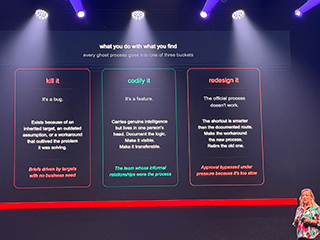
Anca Pintilie, who previously led marketing transformation initiatives at Amazon, described something many organizations quietly struggle with: “ghost processes.”
These are undocumented dependencies, informal approvals, inherited workarounds, tribal knowledge, and pressure-driven shortcuts that keep operations running. The most important observation: The real operating model often does not exist in the org chart, the process documentation, or the workflow diagrams. It exists in people.
That becomes dangerous in an AI era. Many organizations still operate in structures originally designed to compensate for limitations in technology. Over time, employees built invisible bridges between disconnected systems, missing processes, and organizational silos. Some of those workarounds became institutionalized. People built careers around navigating complexity nobody fully documented.
Now AI enters the picture. And suddenly organizations try to automate processes they do not fully understand themselves. This is why discovery work matters more than ever. Not shallow requirements gathering. Real operational discovery.
The kind that asks uncomfortable questions:
- What decisions get made before the meeting officially starts?
- What knowledge only exists because someone remembers it?
- Which activities survive because they are measurable, not because they are valuable?
- What step gets skipped when pressure increases?
- Which metric changes behavior and which one only gets reported?
These questions reveal operational truth. And operational truth matters because AI will amplify whatever system already exists underneath. If the foundation is fragmented, AI scales fragmentation. If the process is strong, AI scales productivity. This is one of the reasons why at Chapman Bright we often start with process mapping, stakeholder discovery, governance discussions, and operational maturity before jumping into tooling.
Because this is not primarily a tooling problem. It is a capability problem.
2. Companies do not transform. People do.
Another strong theme throughout the event, especially in the session by Veronika Kryuchkova, Global Head of Capability Building at The Marketing Academy at Reckitt, was that transformation failure is often misunderstood.
Organizations frequently talk about “resistance to change.”
But what if resistance is not the real issue? Veronika Kryuchkova framed it differently.
People internally ask themselves five very human questions during transformation:
- Do I still matter in this new world?
- What does “great” now look like?
- Can I actually do this?
- How do I succeed here?
- Who do I rely on now?
That framing is important. Because most AI discussions currently focus on technology capability, while the real bottlenecks are often clarity, confidence, capability, trust, and leadership behavior. This also explains why so many AI initiatives stall after pilot phases. The tooling works. But the organization does not structurally adapt around it. People revert back to old behaviors because the new standard was never embedded into daily work.
One insight from Veronika Kryuchkova that particularly stayed with me: “What gets recognized becomes the real standard.”
That sounds simple. But it exposes a huge issue. Many leadership teams verbally push AI adoption while still rewarding old operating behavior. Organizations ask people to experiment, automate, redesign workflows, and challenge assumptions.
Yet recognition, visibility, incentives, and promotions still reward:
- firefighting
- manual heroics
- reactive execution
- local optimization
- activity volume instead of structural improvement
You cannot build a modern operating model while rewarding legacy behavior. This is also why we strongly believe enablement cannot be separated from transformation. Training alone is insufficient.
People need:
- clarity on the new standard
- practical workflows
- governance
- confidence-building
- operational support
- leadership reinforcement
- human-in-the-loop structures
AI adoption is ultimately an organizational design challenge. Not a prompt engineering challenge.
3. AI changes the balance between execution and judgment
Carlos Doughty’s session on redesigning marketing organizations for the AI era focused heavily on how AI changes the nature of marketing work itself. Historically, many marketing teams spent the majority of their time on execution:
- campaign setup
- content formatting
- reporting
- segmentation
- coordination
- administration
- production work
The claim was made that AI fundamentally inverts that balance. Execution increasingly becomes automated. Judgment becomes more important. That observation strongly resonates with what we already see happening in practice. The organizations that benefit most from AI are not necessarily those using the most tools. They are the organizations redesigning workflows around:
- orchestration
- decision quality
- governance
- operational alignment
- data structure
- business context
- human oversight
This is also where many current AI narratives become too simplistic. People often ask: “Will AI replace marketers?” That is probably the wrong question. A better question is: “What work should humans still own when execution becomes close to infinite?”
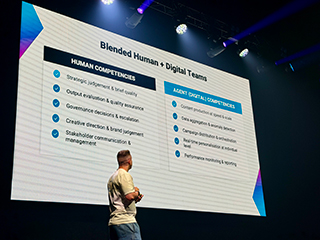
Carlos Doughty described future organizations as blended human and digital teams. I think that framing is useful. Machines increasingly handle:
- production at scale
- anomaly detection
- orchestration
- monitoring
- personalization
- routing
- repetitive execution
Humans increasingly focus on:
- strategic judgment
- quality control
- governance
- creativity
- stakeholder alignment
- prioritization
- systems thinking
- exception handling
This also aligns with our own perspective at Chapman Bright. AI should not remove humans from the process. It should remove unnecessary friction from the process. The goal is not replacing people. The goal is enabling people to focus on higher-value work.
4. AI without operational discipline creates fragility
One of the strongest observations during the event came from Anca Pintilie: Stack investment without operational discipline amplifies fragility.
That line stayed with me. Because many organizations currently mistake AI experimentation for transformation. Rolling out ChatGPT licenses is not an operating model. Adding copilots to workflows is not governance. Building disconnected AI experiments is not scalability. This is where many organizations risk repeating mistakes from earlier MarTech waves. We already saw this happen with:
- marketing automation
- low-code/no-code tooling
- CRM implementations
- customer data platforms
- campaign operations
Without structure, governance, ownership, and operating principles, complexity compounds. And AI accelerates that compounding effect. That is why some of the strongest organizations at the event focused heavily on:
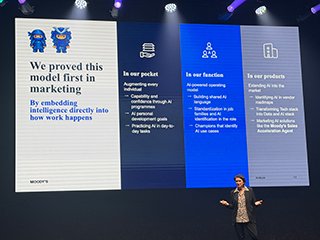
- shared AI language
- role clarity
- workflow standards
- governance frameworks
- capability building
- operating models
- practical enablement
- roadmap-driven adoption
Not just tooling. This is also why we increasingly position automation and AI as operational capabilities instead of isolated projects. The organizations that will outperform are likely not those experimenting the fastest. But those institutionalizing productivity gains most effectively.
5. Signal-led organizations will outperform campaign-led organizations
Dr. Christine Bailey, former global marketing leader at Moody’s and fintech scale-up PassFort, focused on the shift from campaign-led execution toward signal-led operations.
The observation: Most of the B2B buying journey now also happens without direct interaction with vendors.
Buyers increasingly rely on:
- peer networks
- independent research
- communities
- digital signals
- AI-assisted discovery
That changes the game. Reach alone matters less. Context matters more. Timing matters more. Signal interpretation matters more. This is where AI can genuinely create enormous value. Not by generating more noise. But by helping organizations:
- detect intent
- identify operational patterns
- route opportunities faster
- enrich context
- prioritize focus
- align sales and marketing decisions
One phrase from Christine Bailey’s session captured the challenge perfectly: “Without contextual intelligence, activity becomes noise.”
That is highly relevant for many B2B organizations today. Because many teams are still drowning in disconnected activities:
- disconnected campaigns
- disconnected tools
- disconnected reporting
- disconnected ownership
- disconnected customer signals
AI can absolutely improve this. But only when embedded into structured operational systems. Otherwise organizations simply automate more disconnected activity.
6. The future winners will combine AI with operational realism
One thing I appreciated about AntiCon was that many speakers moved beyond simplistic AI hype. Richard Shotton’s keynote on behavioral science and AI especially reinforced that technology alone is rarely the differentiator. The organizations and marketers who understand human behavior, decision-making, and operational reality best are likely the ones that will outperform.
The more mature discussions consistently returned to operational realism.
Not: “How can we use more AI?”
But: “How should work structurally change?”
That is the more important question. And honestly, many organizations are still early. Not because they lack tooling. But because:
- processes remain fragmented
- governance remains unclear
- systems remain disconnected
- data quality remains inconsistent
- ownership remains blurry
- enablement remains shallow
- operating models remain reactive
This is why we believe automation and AI adoption should be roadmap-led instead of request-driven. Organizations need:
- operational clarity
- measurable hypotheses
- governance structures
- scalable workflows
- human-in-the-loop safeguards
- capability building
- structured prioritization
Otherwise AI becomes another layer added onto already overloaded systems. And overloaded systems eventually break.
Final thought
If I would summarize my biggest takeaway from AntiCon in one sentence, it would probably be this: AI is forcing organizations to confront operational truths they were previously able to ignore.
That sounds uncomfortable. But it is also the opportunity. Because organizations that redesign workflows, governance, data structures, and operating models intentionally now will likely create enormous long-term advantages. Not only in productivity. But in adaptability. And adaptability may become the most important capability of all.
At Chapman Bright, we strongly believe the future belongs to organizations that combine:
- human judgment
- structured operating models
- automation
- AI
- governance
- measurable value creation
Not as isolated initiatives. But as connected systems designed to compound over time. Because in the end, AI is not the goal. It is the vehicle. The real transformation is how organizations redesign work itself.